


 On the occasion of the Greek publication of the children’s book The First Great Journey by Kouinta Editions, we met with Nina Koevoets, a peace educator with extensive international experience in conflict management. With studies in psychology, political science, and nonviolent communication — and years of work in India, Israel–Palestine, and across Europe — Koevoets uses her first children’s story to introduce key principles of her work to a young audience.
The book follows four young swallows on their first big journey, offering a simple and direct introduction to different conflict styles and to ways in which children can recognize and manage their emotions. The author speaks about “navigating conflicts” and about how understanding differences can become a tool for cooperation. In the interview that follows, she explains how the idea for the book emerged, how it connects to her educational work, and what she hopes young readers will take with them as they join the four birds on their journey.
Ms. Koevoets, you have dedicated your life to peace education and conflict transformation on an international level. Why did you think that peace education should also begin with a children’s book?
From both my personal experience and looking at the world we live in, I see there is a huge gap of knowledge about how we can be more peaceful. I grew up in a peaceful household, where there was room for negotiation, but where conflict and anger were also often avoided and suppressed. At school I was bullied for a while and no-one seemed to know what to do. In history class we had to learn about different wars and peace seemed to be just their absence. I completed a master degree in Conflict Resolution, in which we never discussed the conflict styles that inspired my children's book. Nonviolent communication and nonviolent action, were not part of my studies. So, when I went to a training program in the US where I learned about these things, it was a turning point in my life. Here I learned about Conflict Resolution not as diplomacy and academic political analyses, but practices anyone could learn. But sadly, such knowledge and skills are not part of our education. As a result many people lack skills to constructively deal with conflicts and by the time we're adults we have to 'unlearn' behaviors that have become patterns, besides learning something new. Therefore, we must start with the children.
In your new book, four young birds get into a conflict. The personalities of the four birds are based on different conflict styles.  Which of these styles do you encounter most often in children — and which in adults?
Being able to see something from someone else's perspective is something that is hard for younger children, so before the age of seven or so, we cannot expect children to do that. Young children will thus tend to prioritize their own needs, simply because they cannot see yet what the needs of others may be when those aren't communicated to them. Because of that children and their parents may get into a competition. If the adult is imposing their will, the child will learn to accommodate, to stay safe. And if the adult accommodates, the child will continue to compete. Adults and children may also avoid conflicts to maintain 'harmony', but this can result in distance or unresolved issues. Only if the adults choose problem-solving, they can step out of this dynamic. Problem-solving is a response to conflict that can actually strengthen relationships.
However, while conflicts are a part of daily life, we don't magically get better at handling them just because we're getting older, unless we make an effort to learn how that can be done. I have thus not seen that adults are better at problem-solving than children. That's why it's so important that both children and adults learn this skill.
If a child recognizes themselves in one of the birds, what is the first step you would encourage them to take the next time they feel angry or hurt?
Of course ideally, we avoid conflicts to escalate. To do so it's important to pause and think “how do I want to respond?” instead of reacting immediately. However, that's hard for a child, because their brains are still developing and strong emotions temporarily 'shut off' the rational part of the brain.[1] Once they feel calm, children are perfectly capable to solve conflicts. To do that, it's important that they learn to listen to themselves and each other. A child can ask themselves what is important to them and express that, and listen to what is important for the other person. However, it's helpful if this can happen in a safe container, held by a mediator.
In the book the main conflict is between the brothers: one wants to be fast, while the other is slow. When they are going on a long journey with the rest of their family their conflict jeopardizes the journey for the whole group. It is thus important that they find a way to resolve their conflict. Their sister helps them to do so, with support from the teacher. Children will often need our support or encouragement, but don't need us to solve things for them. So, we cannot simply ask the child to “take the first step,” but they need to know that there is someone who can help them.
 Is your story of the four young birds in a way, a reflection of our wider society?
Yes, definitely so! Of course most people use more than one conflict style, unlike the birds in the book. Your personality doesn't limit you to just one style, but we can recognize these responses to conflict in our society, in different situations. Also, while I haven't seen a big difference between adults and children, I did observe a gender difference: men more often compete and women more often accommodate or avoid. And as we live in a patriarchy where man “make the rules”, the dominant story is that we're in a constant competition with one another. However, we could look at humanity as all being on a “Great Journey” together. In this journey of life, we have to learn how to cooperate. With all of the natural destruction we've caused, cooperation has in fact become an existential skill.
Here it's important to notε that cooperation has to be on the basis of equality. We should not cooperate with others trying to dominate (i.e. accommodation). Nor do we have to compromise. Most people tend to see conflict as a win or loose situation or an either/or problem, so solving a conflict is perceived as making a compromise. However, the idea of problem-solving goes beyond the win-loose mentality by looking for a win-win solution. A win-win solution is a solution that works for everyone. If we could look for win-win solutions more often, this will increase the well-being of our entire society.
Having lived and worked in regions marked by deep political and social tensions, such as India and Israel–Palestine, what have these large-scale conflicts taught you about the smaller, everyday conflicts children experience?
In Israel-Palestine I witnessed a shocking level of oppression. Living in the occupied territory of the West-Bank, I experienced crossing check-points, being shot at with tear-gas and rubber coated bullets, power and water cuts and I talked to people whose lands were stolen, houses were destroyed, who's friends or family members were killed or imprisoned, or who were denied medical aid. In my privileged life in The Netherlands I never went through such things or talked to such people, so it took me quite some time to process it, because knowing something is different than experiencing it. I didn't only travel in the West-Bank though, but also went to different places in Israel and spoke to Israeli citizens, activists and a few settlers. They are clearly suffering too. And that strengthened my belief that there are no “winners” in violent conflicts, but only losers.
Following the devastation of Gaza in the last two and a half years also strengthened my belief that trauma is passed on when it isn't healed. This is the main reason that peace is far away. On a theoretical level there are solutions, but people are not ready for these on an emotional level. And because of that they get trapped into a continuous spiral of violence. It is very challenging to break such a cycle on a social level. There are groups of Israelis and Palestinians who see each other's humanity and recognize the need to work together, but they consist of a minority.
Living there was a very important experience for me that opened my eyes and my heart. I am more aware of my privilege and more resilient in the face of misery. I also better understood the colonial heritage of Europe and how much damage it has done. It motivated me to become a peace educator, here in Europe where things may look peaceful, but where there is still a lot of violence beneath the surface.
What this taught me in relation to smaller conflicts is that solving a conflict is a lot harder when there is a power difference and when there is trauma. There is also a power difference between children and adults, so as adults we have to be very careful not to abuse this power, but rather approach the children with the same respect as we have for equals, while at the same time we are aware of our responsibility to guide them and invite them to problem-solve with us about the everyday conflicts in our lives. I am a parent myself, so I know this requires commitment and self-compassion for the instances we didn't live up to these principles.
Instead of speaking about “conflict resolution,” you use the term “navigating conflicts.” Why do you believe that conflicts cannot always be solved, but can be navigated?
As I explained, some conflicts are difficult to resolve, because of power-difference and trauma. Moreover, it can be hard to find a practical solution too when people really cling to certain strategies. But very often dialogue can create mutual understanding and also gives more insight what are the approaches we can take in the conflict.
There are different terms we can distinguish when it comes to dealing with conflicts:
Prevention: taking measures that a conflict doesn't arise.
Conflict Management: ensuring that a conflict does not cause too much damage, or in other words de-escalating conflict.
Conflict Resolution: finding a specific solution to a conflict or problem, often in a more goal-oriented or task oriented way. The relationship between conflicting parties is of less importance.
Conflict transformation: changing the conflict by improving the relationship between the parties and transforming their perception and feelings about the conflict (thereby moving beyond the conflict, or “transcending” the conflict). Conflict transformation is a process-oriented approach.
Conflict navigation is an "umbrella term" for all of these. We can determine whether there is a conflict that can be transformed, resolved, managed or prevented and act, or “navigate,” accordingly. It can be helpful to let a person not involved in the conflict mediate, to facilitate listening and understanding and help people find a mutually agreed solution. This can be applied in schools by teachers/staff or peer mediators (i.e. students mediating between students).
In the book a sister mediates between her siblings and the birds are able to transform the conflict. Through the conversation the bird who wanted to fly fast, pushed his brother and left the group, was able to understand that his behavior was damaging for others and he had to learn to cooperate in order to function within the group. Getting an important task, looking after his brother, helped him to take responsibility.
Do you believe that a culture of peace can be taught? And if so, what role does storytelling and children’s literature play in shaping  that culture?
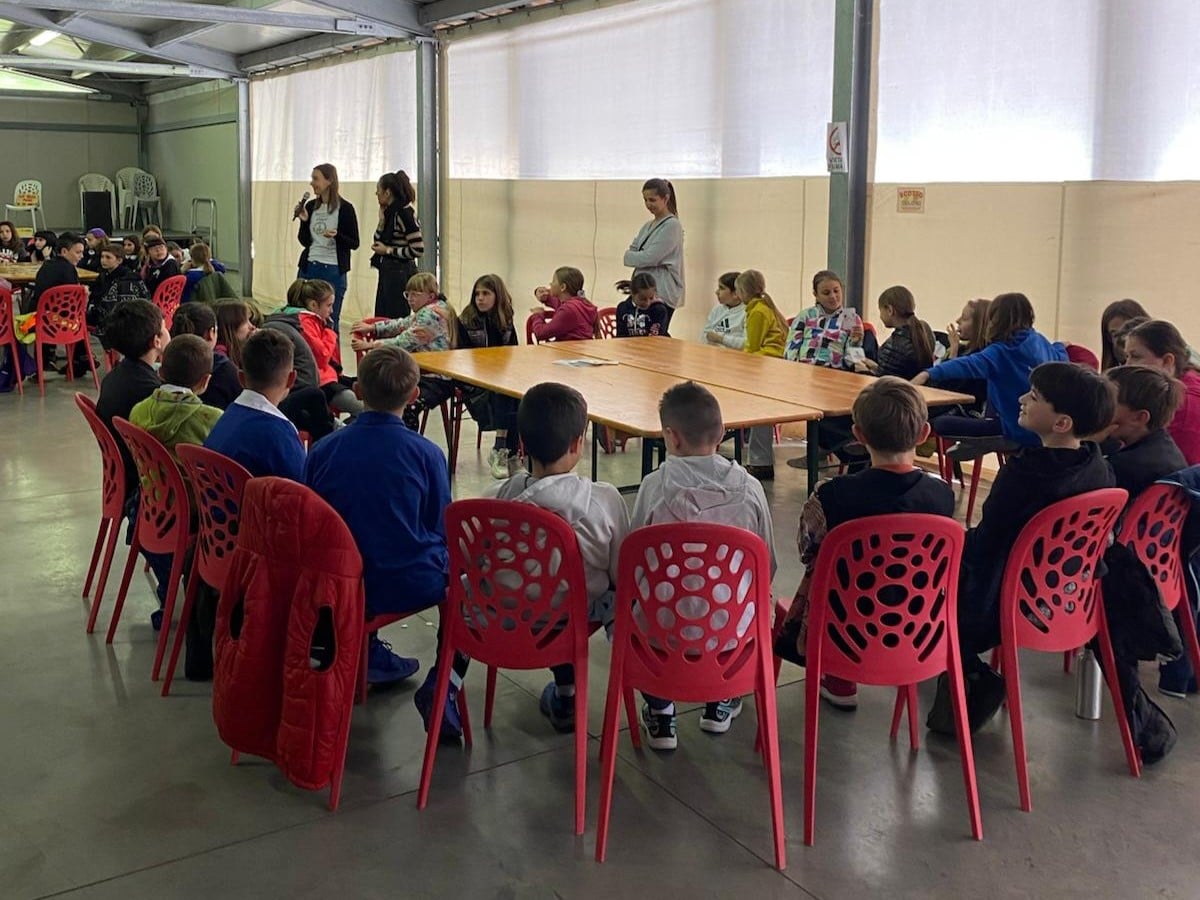
Peace education is vital for the development of a culture of peace. Just as we are taught a culture of violence, we can be taught a Culture of Peace. We can teach children not to normalize violence, not to justify or accept it, or perpetrate it. Instead we can teach empathy, compassion and creative problem-solving. We can teach respect and solidarity. Stories can expand our imagination of what is possible. So stories are a very important tool in education and education is a crucial way to build a culture of peace. In fact, I hope that schools in Greece will find inspiration from the book and start to think of ways they can integrate mediation into their work. For this purpose there is an explanation of the process in the back of the book. Schools can also invite me to speak with the children and teachers about this. In The Netherlands already thousands of schools have implemented such programs in the last decade or so, but last year I've been to five schools in Italy and would be happy to do the same here in Greece where there are also still very few schools that practice mediation.
Nina Koevoets studied psychology and political science (at the universities of Leiden and Amsterdam). After completing her master's degree (Conflict Resolution and Governance, 2007), she was a trainee at the Metta Center for Nonviolence (USA). She worked for five months in India and stayed for over a year in Israel-Palestine. She then completed another master's degree in Global Studies, in Sweden in 2013. In 2015, she conducted her first training course in the Netherlands. Since then, she has been organizing training courses in various countries, with funding from the European Union. She published two more books (for adults): The Peace Compass, 2024, and Engaging Nonviolence: Activating Nonviolent Change in our Lives and Our World, published by Pace e Bene (USA), which she co-authored. In addition, she has developed two collaborative games for a more peaceful and sustainable world. She received a peace medal from the Coalition Peace Missions Without Weapons (Netherlands, 2018) and an award for her overall contribution to peace education from The Visioneers International Network (Canada, 2022). She was born in the Netherlands and lives in Greece. To learn more about her work, visit: www.peace-power.org