


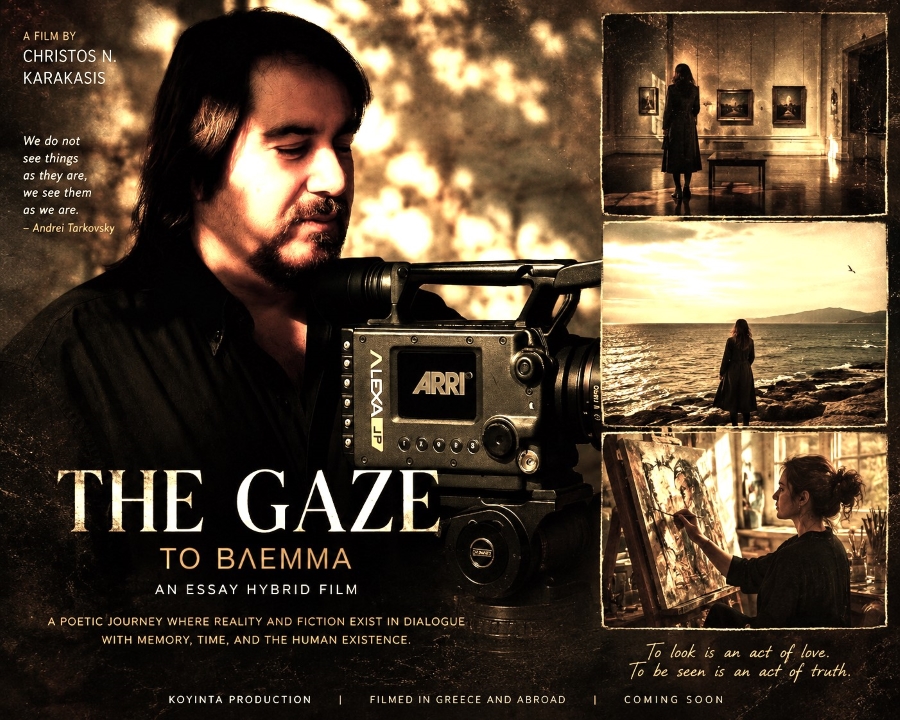
 Towards a Poetics of the Gaze A Film by Christos N. Karakasis . Cinema has often been described asthe art of capturing time. Yet before it captures time, it captures a gaze. Every image begins with someone looking. Every frame is the result of a decision—where to stand, what to observe, what to leave outside the frame. The act of seeing is therefore never neutral. It is already an interpretation of the world.The Gaze was conceived from this simple premise: that cinema is not merely a medium that records reality but one that reveals the invisible dimensions hidden within it. Images do not simply preserve what once existed. They transform memory into presence, silence into language, and absence into a form of human experience.
Rather than following a conventional narrative, the film unfolds as a cinematic essay in which fiction and reality coexist without rigid boundaries. Characters, places, fragments of conversations, inner monologues, and moments of silence become equal elements of a cinematic composition. The fictional narrative does not oppose reality; instead, it becomes another way of approaching it.
The journey extends through different cities, landscapes, and cultural spaces in Greece and abroad. Streets, museums, theatres, rivers, train stations, airports, churches, galleries, and anonymous urban environments are not presented as geographical locations alone. They become emotional landscapes where memory, history, and personal experience intersect. Every place carries traces of those who have passed through it, just as every image contains echoes of other images.
At the centre of the film lies a fundamental belief: that every human being experiences the world through an entirely unique gaze. Reality is never identical for two people. What changes is not only what we see, but the invisible world we bring with us while looking.
Throughout the film, ordinary gestures acquire unexpected significance. The preparation of a cup of Greek coffee, the slow movement of pedestrians crossing a city, the first brushstroke on an empty canvas, a phone call that remains unanswered, a train disappearing into the distance, rain falling on the Thames, or a silent glance exchanged between strangers. These are not narrative events in the traditional sense. They are rituals of existence—small acts through which time quietly reveals itself.
The film also reflects upon the relationship between cinema and memory. Memory is not presented as a reconstruction of the past but as a living presence that continuously shapes the present. The people we have lost remain within our gestures, our thoughts, our silences, and our imagination. Absence is never empty; it becomes another form of presence.
Art itself becomes one of the film's central subjects. Painting, theatre, literature, philosophy, and cinema are not treated as isolated disciplines but as different expressions of the same human necessity: the desire to resist oblivion. Every artistic creation is an attempt to preserve a fragile moment against the relentless passage of time.
The Gaze also acknowledges the filmmakers and artists whose works have profoundly transformed the language of cinema. Rather than imitating their aesthetics, the film seeks to engage in a dialogue with the history of moving images. Every new film inevitably carries within it fragments of those that came before. Cinema is a continuous conversation across generations.
In an era saturated with images, The Gaze proposes a different rhythm. It invites the viewer to slow down, to observe patiently, to rediscover silence, and to experience duration as an essential cinematic element. The film does not aspire to provide answers or construct definitive meanings. Instead, it creates a space where contemplation becomes more important than explanation.
Ultimately, The Gaze is less concerned with telling a story than with exploring the conditions that make every story possible. It asks how images shape memory, how memory shapes identity, and how the simple act of looking can become an ethical and poetic way of inhabiting the world.
Every spectator completes the film differently. Each brings personal memories, losses, desires, and expectations into the viewing experience. In this sense, the final image of The Gaze is never projected on the screen. It exists within the consciousness of the viewer, long after the projection has ended.
Perhaps this is the enduring power of cinema. Not that it allows us to see the world differently, but that it quietly transforms the way we learn to look.